ElecHub Lab
DC-DC · WIRELESS POWER · CAPACITOR
Power electronics design, from spec to verification.
Describe your power stage in plain language. A deterministic engine designs the DC-DC converter, wireless power link or capacitor bank, sizes every component, and hands you a verifiable engineering report.
scooter-pad-240w.wpt — LCC-S● CONVERGED 3.2ms
Tools
DC-DC / WPT / Capacitor bank
Topologies
Buck · Boost · SS · LCC-S
Verification
SPICE cross-check
Output
Engineering PDF report
Design tools
DC-DC
DC-DC converter design
Size buck, boost and bridge stages from your input/output spec, with IC and finished-module recommendations.
OPEN IN WORKBENCH →
Wireless power
WPT wireless power design
Solve SS, SP, LCC-S and double-LCC compensation from air gap, power and voltage targets.
OPEN IN WORKBENCH →
Capacitor bank
Capacitor bank design
Build series/parallel banks to hit capacitance, ripple current and voltage — linked into your converter or WPT design.
OPEN IN WORKBENCH →
How it works
01
Spec capture, in conversation
State power, voltages, currents and constraints in plain language — Korean or English. The AI co-engineer turns them into a formal requirement set and flags what is missing.
"킥보드 패드 240W,
공극 15mm"
→ P=240W, gap=15mm
공극 15mm"
→ P=240W, gap=15mm
02
Deterministic physics, not AI math
Every number comes from a regression-locked analytical engine — the AI proposes, the solver disposes. Component values, currents, losses and impedance are reproducible to the digit.
solve_lccs(f₀, k, RL)
✓ ref-vector match
3.2 ms
✓ ref-vector match
3.2 ms
03
Schematics, sweeps, reports
Live schematics with editable values, frequency-response and impedance sweeps, time-domain waveforms, SPICE verification — exported as a report you can put in a design review.
Inside the workbench
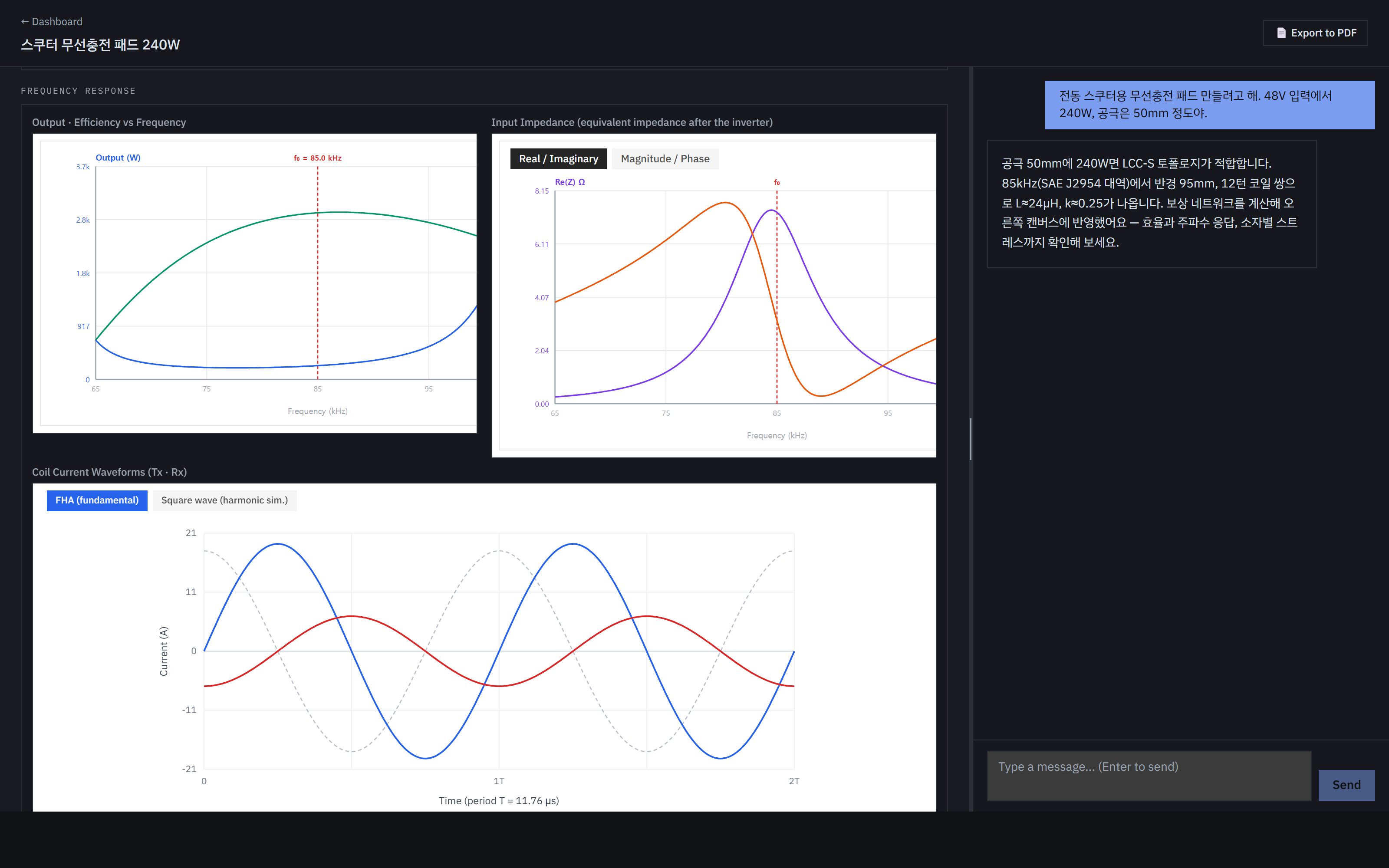
WPT design session
Frequency response, input impedance and coil-current waveforms, solved live from a conversational spec.
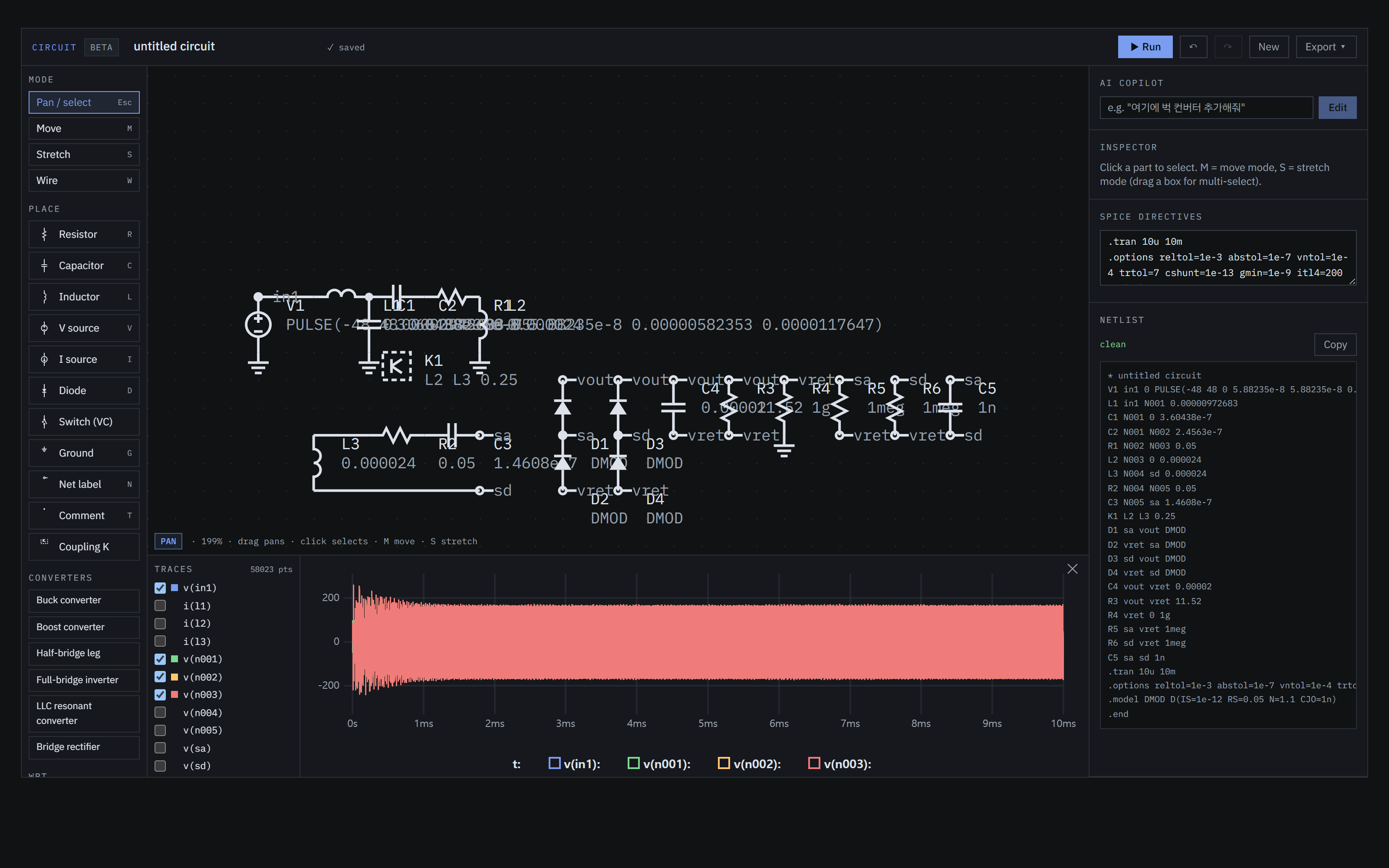
Circuit editor + SPICE
Draw the full power stage, run transient simulation in the browser, and inspect the generated netlist.
SPICE-VERIFIED
Every topology is cross-checked against ngspice transient simulation — the benchmark suite is public.
Your next power stage, solved before coffee.
Free tier includes full solver access and exported reports across all three tools.